Sunday, May 3, 2009


The battle of Stalingrad was one of the most significant battles in history. It was the turning point in the war, and it was also the bloodiest battle in history. Our book like always just skimmed over the top of the battle and didn’t give justice to the Russian soldiers that held Germany’s 6th army from July 17th until February 2nd.
On June 22, 1941, Hitler had the marvelous Idea that he would capture Soviet Russia for additional Lebensraum, as well as their oil fields which he would need if he was to keep waging war against the rest of the world. He invaded Russia along a 1,800 mile front with over 600,000 motor vehicles and thousands of planes and tanks, as well as an additional 3 million Soldiers. And in the beginning of the campaign, it went how he had hoped, with over 500,000 square miles of Russia under Nazi control, and before the end of the war, over 5 million Russian casualties. Hitler couldn’t have been happier with his decision to invade Russia, that was until the city of Stalingrad refused to surrender, despite the relentless shelling of the city, they refused to give up their city. The Nazi’s were doomed, Stalin had ordered that all the civilians stay in the city in belief that the presence of civilians would encourage the soldiers to fight not just for the city, but also for the safety of their families and friends. And the Russians fought on their home turf, they fought within the bosom of Mother Russia herself, and they were willing to kill themselves for mother Russia, let alone an enemy soldier. Every step the Nazi’s took into Mother Russia was a step closer to the soldier’s families; every additional step they took into Mother Russia was an additional step the Russians wanted them to take back.
The Nazi soldiers were soon ordered to stop shelling the city and occupy the city; after all, after one thousand tons of bombs were dropped on Stalingrad, how many could be left? The Nazi’s were about to find out. When the Nazi’s moved in they found out that all their shelling had done was provide the Russians with fortresses of rubble throughout the city. Stalin ordered no retreat, “Not one step back!” was the slogan that was most common among the Russian soldiers in the city. And it worked, the advancing Nazi soldiers suffered heavy casualties against the tenacious Soviets.
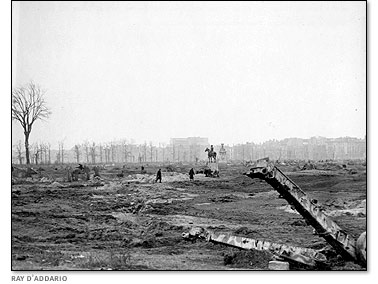
Though while Hitler focused all his attention on Stalingrad, he refused to recognize the flanks around the city and gave no aid to the axis powers guarding his back while he attacked the city, and the Soviets planned to exploit this to its fullest extent and surround the Nazi forces in the city. Operation Uranus was planned to crush the Romanians guarding the northern flank, then the Nazi’s army would be caught like a dog with its head in a hole trying to catch a mole. Operation Uranus was commenced on November 19th 1943 and was a success, the ill armed and poorly trained Romanians were thinly spread across the northern flank and were decimated by the determined Russians. After the Russians had made short work of the Romanians, they turned their attention to Stalingrad. The Soviets made a pincer and completely surrounded the Remainder of the Nazi’s 6th army, which totaled to about 300,000 men. After the German force had been completely surrounded, the soviets dug in and trapped the Nazi’s within the city, they were going to let the Nazi’s experience winter Mother Russian style, with no supplies. The desperate 6th army tried to break through the Russian line, but the Russians kept the Nazi’s encircled. The Russians letting the Nazi’s experience what they had experienced for the last 5 months, a brutal siege. The superiority of the Luftwaffe over the Russians air force could not even help them, every day the 6th army required 300 tons of supplies, yet they never received more than 120 tons a day. Soon, the Nazi soldiers didn’t even have the strength to unload the supplies from the planes, and Hitler refused to send a force to break the Russian line and get his soldiers back. He said that the soldiers would never leave the city, that if they failed to capture it then they deserved to die. Not only this, but when the Nazi army was encircled, he promoted the 6th army’s commander to the position of Field General, knowing that no Field General had never lost; Hitler had expected him to commit suicide. But after the Nazi soldiers had been starving for over 2 months, had a meager amount of clothes to survive one of the harshest winters Russia had ever seen, He lost all care for the prestige of the rank that he had received, and surrendered, the Nazi soldiers that refused to surrender alongside their leader were crushed and the city of Stalingrad was successfully recaptured by the Russians. The cost was horrible, over 1.2 Million (40,000 of which were civilians) Russian casualties along with 840 thousand Nazi casualties put the total well above 2 million. Though had it not been for the tenacity of the Russian soldiers within the city, then Operation Uranus would have never been able to encircle the Nazi’s and the entire city of Stalingrad would have been taken and Russia would have been under Nazi rule, and WW II would have ended a lot differently. Instead, after winning the city back, The Russians went on a rampage, they cared not for mercy. To them, the only good Nazi was a dead Nazi. Just as fast as the Nazi’s had marched into Russia, they were muscled out by the vengeful Russians. The Nazi’s didn’t ran out of Russia with their tails between their legs, they retreated back to Berlin, but there was no refuge to be had. The Russians Bludgeoned their way through Germany killing anybody whose allegiance lied on the Swastika, they marched into Berlin and crippled the Nazi’s. Their homeland had been decimated by the Nazi’s, and here they were on Nazi turf, with weapons, and an army alongside them with the same goal in heart, get even. They slashed, stabbed, shot, shelled, sniped, strategized, and stampeded their way to Berlin to pave the streets in Nazi blood and tear the Swastika down from the Reichstag. And in the end, Berlin laid on the countryside like a canvas of destruction warning all those who saw of the dangers of a Russia scorned.

Galatians 6:7
“For whatever a man sows that he will also reap”

This seems like a simple enough Bible Verse, it’s a favorite among parents, “Don’t pick on him, the bible says you reap what you sow” and parents are usually right. Though it seems like the Nazi “Christians” were too busy justifying Hitler’s actions to educate the children on this and soon enough, the children became soldiers on the streets of Stalingrad killing civilians. The seeds were sown, and their seeds began to sprout as they raced out of Russia on their long trek back to Berlin. Soon they were reaping the crops of their actions, and the crops were just as bad as the seeds had been, no one was spared as the Russians Reaped the Nazi’s their biblical justice.
World History, Book B, BJU Press
2007, Greenvillem South Carolina

Wednesday, April 29, 2009

camoriano ~ unit 7

"The Best Way Out Is Through" (can't go under it, can't go over it...)

Have you ever been in a sewer - a pipe or drain that carries away waste or rainwater? Take a moment to think about the most obnoxious, revolting, unbearable, and awful smell you’ve ever had to endure. Sewers are full of nauseating odors. Keep that stench in your mind. Now… imagine being forced to live in such a place for over a year. For 15 dreary months. A young girl by the name of Krystyna Chiger did just that, along with many others. She was a child holocaust survivor. During the war, she hid in the sewers of Lvov, Poland with her family. Here is her story:

“When Daddy found out that there would be a liquidation of the Ghetto, we hid in the cellar. We usually went there in the afternoon when Mommy would come back from work. I was 7 years old then and I knew about everything…

Later we headed for the sewer. It was very wet and dark. I was very scared and I was shaking, but I tried to be calm and only asked Daddy if we still had far to go. There were stones with yellow worms crawling all over. We put all our things over the stones and sat on top of them. It was awful there. Water seeped from the walls and it smelled bad. I saw large, red rats which ran by us just like chickens. At first I was very afraid, but later I got used to it. My little brother, Pawelek, was not scared at all.

This lasted five weeks. We couldn't move or get up. There were 20 other people with us. Every day, from the first day, the Polish sewer workers brought us food: black bread and margarine. They were very nice to us.

I was not allowed to talk loudly; I only whispered into Mommy's ear. I dreamt that the war would end so that we could go out into the world. I missed the sunshine, the air and the flowers. Once, I asked our sewer workers for some field flowers. I wanted to see our dog, but I didn't tell Mommy because she had so many other worries.

In the summer, when the rain seeped in, there was a lot of water everywhere. Then we had to lean very low on the stones right next to the wall so that the water would not flow on us. Pawelek was very small at that time. He was only 3 years old, and he cried a lot. Mommy was very upset because she was afraid that someone would hear us. Once, a man who was hiding with us got so angry at Pawelek that he pointed a gun at him.

After five weeks, other sewer workers found our hiding place. We had to run away. We ran through the main pipe, straight ahead, and we didn't know where we were going. Suddenly, we saw our sewer workers. They were very surprised and asked us where we were going. Daddy told them everything. Then they led us to a side pipe and told us to stay there overnight. In the morning, they led us farther in. While walking, I felt much better. I did not have to sit any more. I walked barefoot in a summer dress. I was shaking from the cold but I felt happy. I got a pin in my foot but I took it out myself because I didn't want to delay the others. We finally reached a cement pipe and we stayed there the whole day. It was so cold there that we couldn't stand it. There was also no place to sleep. The next day our friends led us away again. By then we were only 11 people. The others had died.

The rats always ate our bread. When Daddy frightened them with a stick, they ran away. Pawelek fed the rats as if they were pets. The rats came very close to me and squeaked. One day a lady gave birth to a child. They covered this child with a washbasin. It suffocated and was thrown into sewage.

I could hear cars driving above us. I heard people's voices and children playing and laughing. I thought how happy I would be if I could play like them. I got very sick with measles. Then Pawelek got it from me.

Towards the end of our hiding, I heard the whistles of sirens and the noise of cannons. I was afraid but I knew that our liberators, the Russians, were near! One day we heard a strong knocking on the sewer grates. These were our sewer workers who told us that we were free. For a few minutes we walked through the pipe, then we pulled away the sewer cover and our sewer workers pulled us up on the surface of the earth. We no longer looked like children. People felt sorry for us and one lady bought us gooseberries. I was so happy when I saw the sun, flowers and people. But Pawelek cried a lot. He wanted to go back to the sewer because he wasn't used to the light and he was afraid of people.”


Krystyna’s story continues through her life… showing how she then goes to school, gets a job, marries, and has her own children… all the while being full of joy and peace. How does someone go through so much turmoil and remain... happy? I personally would plead through my eyes, for I wouldn’t dare speak, for someone to notice me - to see my loneliness, my despair. If everything had been taken from me and I was forced to live in a sewer, I’d be an angry girl and full of shame. Yet, I’ve recently realized we all have the choice to be happy or not. Of course there are things that'll sadden and discourage us, but it's ultimately our decision with how we handle it. It's easy to lose hope and stay miserable all the time… coming out of that "sewer" takes a lot of effort, but it's so very important to do. I'm not saying, you can't ever, ever be disheartened. 'cause the Bible does say there is, "A time to cry and a time to laugh, a time to grieve and a time to dance…"

Someone once told me, "Complaining about life is a sin. If you've been unreasonable and stayed in despair… you've forgotten God. You've sinned." Uh-oh, what do I do on a daily basis? Well, I complain: I'm so tired and hungry and bored and I hate school and math is dumb and I just want summer to be here and it's too hard to respect my mom and oh man, laundry time bah I don't want to clean my room and ugh… siblings. I've disobeyed my father who clearly told me, "Do everything without complaining and arguing…"

Even if we live in a sewer, despite the fear that will exist, we have no reason to be discouraged or to grumble. Many Jews were to their breaking point… 6 million lost their lives. If you were in a dire situation such as the holocaust… Would you shrink back in a corner and whimper to yourself or would you insist on being joyful and “Let all that you are praise the Lord; with your whole heart, praise his holy name? Let all that you are praise the Lord; never forget the good things he does for you? For he forgives all your sins and heals all your diseases. He redeems you from death and crowns you with love and tender mercies. He fills your life with good things. And your youth is renewed like the eagle’s!" ~Psalm 103:1-5

Life is not like a children's fairy tale, whose purpose is to entertain and have no evil consequences… we will be disappointed and often end up in the sewer, but we must remember the best way out is always through.

Pawelek and Kyrstyna


sources:
“Krystyna's Story.” 28 April 2009. Anti-Defamation League.
http://www.adl.org/children_holocaust/children_main1.asp

NLT Bible. 28 April 2009. www.biblegateway.com

Tuesday, April 28, 2009

Temple ~ Unit 7

Ravaged by war, key to the defeat of France, and completely controlled by Nazi's Belgium fell quickly to Germany's quick blitzkreig offensive. Bruges, a key city in Belgium was used during World War I as a harbor for U-Boats, and was a key coastal city in Belgium during World War II. Even though it was the center of much fighting, Brugge to this day has managed to keep much of its historic monuments, and much of its heritage intact. The city is beautiful, and when I last visited it in June of 2008, it was an amazing experience.

The city of Bruges, on the North West coast of Belgium is a walled city with many dutch tendencies. In the time of World War II, windmills were built in and around the city for uses such as grinding up grain. Canals were widend to allow for easy transportation of goods, and the city has thrived. Today, much of the city can be easily seen on bike, which lends itself for an extremely fun and easy tour of the city. The city still has some signs of the second World War though. Many museums in the city have preserved artifacts and items depicting what life was like during the war, and in many of the rock gates leading to the city, the scars of war have not been completely erased with time. Although much has been restored in the city, many of the original roofs on houses remain. Monuments are present that commemorate various battles fought around Bruges, and the city is over all extremely beautiful. One of the first battles where gas weapons were used, was used on a troop of over 18,000 Dutch troops in Bruges, over 2000 of them died. I was amazed to find how they maintained their heritage, such as games that have been passed on. Once a month they have a festival in the town where people play classic games, and eat heritage food. I happened to be there when this went on, and it was rather amazing. There were many many people of all ages playing all kinds of different games. This is a historic town and I wanted to share my experiences in seeing first hand some of the places hit by Germany in both World Wars, what is amazing is how historic the people in this town have kept it, all the way down to teaching their children games their Grand-parents used to play.

Isaiah 38:18-20: “18 For the grave cannot praise you, death cannot sing your praise; those who go down to the pitcannot hope for your faithfulness. 19 The living, the living—they praise you, as I am doing today; fathers tell their children about your faithfulness.20 The LORD will save me, and we will sing with stringed instruments all the days of our lives in the temple of the LORD."

This city has preserved its heritage well, they have kept telling their children what happened, taught them about everything that went on. Wouldn't it be so much better if they were telling their children what the Lord had done for them during the war, and given their children the faith of their for-fathers?

Here are some pictures I took while I was in Bruges:


Citations:

A Brief Historical Background of Brugge. 2009 April 29 (http://www.brugge.be/internet/en/toerisme/geschiedenis.htm)

NIV Bible. 2009 April 29 (biblegateway.com)

Just for the record, in English we spell it Bruges, but really it's spelled Brugge.

28 Years ~Robin Smeda

9,220 days, 221,280 hours, or 13,308,000 minutes. Imagine being separated from a loved one for that enormous amount of time; isn’t it a horrifying thought? This was a reality for those who lived in Germany from 1961-89. For twenty-eight years, Germany was split into East (Communist) and West (non-Communist) Germany by the Berlin Wall, slicing a people group in half…tearing apart a nation. And, it all began August 13, 1961. (The following story is almost completely fictional.)

I awoke to the hushed whispers of my mama and papa. With my stomach grumbling for breakfast, I almost ran to my parents to ask when to expect our morning meal, but even at my young age of seven, I knew not to interrupt such a conversation. Laura, my twin sister, normally would’ve been sleeping at my side, just as anxious as I was to get the day started, but she was at Oma and Opa’s (Grandma and Grandpa’s) house for the week, so there was no one to whisper with while I waited. When the whispers stopped, I leaped out of bed and rushed to change out of my bedclothes, curious to understand the urgency and secrecy behind my parent’s hushed conversation.

“Guten morgen, (Good morning) Mama and…” I halted abruptly. Mama turned away quickly, but I had already seen her flushed, tear-streaked face. Papa gently took my hand.

“Anna, let us go for a little walk while Mama makes breakfast, ja?” Papa said softly.

The warm August sun was already rising in the east as father and daughter strolled in silence. Papa cleared his throat several times, but no words came. Small bubbles of panic began rising with me. Finally, he spoke.

“Anna, kleine (little one), I have difficult news, but do not worry too much.”

“Papa, what is it?” The question burst through my trembling lips.

“You know the wall that goes through the city with the little gate that makes it hard to get to Oma and Opa’s house? Well, they closed the gate this morning, and we won’t be able to go to Oma and Opa’s house for a while…”

“But, but…What about Laura? When is she coming home. Papa!” I stopped. “Papa. Why was Mama crying?” A chill ran up my spine.

“Shhh, shhh, kleine. Your papa will bring Laura back. Don’t worry, Anna. Everything is going to be alright.”

His words were meant to soothe me, but I couldn’t stop crying. In the pit of my stomach I knew. I knew he was lying to me. Tears soaked my pillow every night after that. I knew.

Eleven days after that horrible morning, I woke up, again, to my mama and papa whispering. Had I gone back in time? Had it all been a nasty nightmare? I didn’t wait for the whispering to stop this time; I had to know!

The pitter-patter of my running footsteps echoed in the hallway to the kitchen. Mama and Papa were in the kitchen just like before. And, Mama was crying just like before. But, something was different too…Papa didn’t say that everything was going to be okay. No. Papa was, Papa was…crying?

“P-P-Papa?” I choked out.

“Shhh, shhh, kleine. Everything is going to be okay,” Mama said and looked quickly away from my eyes. I knew…Mama lied.

That was the last time I saw Papa. He, Gunter Litwin, was the first of 171 people killed by the border patrol guards at the Berlin Wall. My heart broke that day. Twenty-eight years later, however, a piece of my heart healed. Laura came home. I’d waited an eternity…but now I could believe, maybe, that some things were going to be okay.


“I am weary with my moaning; every night I flood my bed with tears; I drench my couch with my weeping” (Psalm 6:6). Yet, we (Christians) can still rest in this promise: “‘Blessed are those who mourn, for they shall be comforted” (Matthew 5:4).


Berlin Wall Online. 28 April 2009 http://www.dailysoft.com/berlinwall/history/escape.htm
Dict.cc dictionary. 28 April 2008 http://www.dict.cc/?s
English Standard Version Bible. Wheaton, Illinois: Crossway Bibles, 2006.

The Battle of Mogadishu


Dakota Evans: Unit 7
October 3-4, 1993, has gone down in history as a black day for the U.S. Army, and referred to today as the First Battle of Mogadishu. That’s when a mission to capture key lieutenants of Somali warlord Mohamed Farrah Aidid turned to disaster when two Army Black Hawk helicopters were shot down over downtown Mogadishu, Somalia. Somalia at that time was a nation in anarchy, and a United Nations relief effort to supply food to the starving people was being hijacked by various warlords, either to sell the relief supplies on the black market or keep it for their own personal use.

What began a "snatch and grab" operation turned into a desperate rescue mission—in the heart of Aidid’s personal fiefdom. The Americans were quickly besieged by heavily armed mobs (calling these thugs soldiers would be an insult to soldiers around the world) who were determined to wipe them out. What followed was a story of incredible selflessness and bravery on the part of the Army Rangers and Delta Force soldiers who found themselves trapped in a situation they were ill-equipped to deal with, a mission that was supposed to last 45 minutes but stretched into an 18-hour ordeal and left 18 Americans dead and dozens wounded, not to mention the estimated 1,000 Somalis killed.

In January 1991, the President of Somalia, Mohammed Siad Barre, was overthrown by a coalition of opposing clans called the United Somali Congress. As a result, the coalition was divided into two groups—one led by Ali Mahdi Muhammad who later became President, and the other by Mohammed Farah Aidid. There were four opposing groups who continually fought over the domination and control of Somalia. In late September of 1991 Mogadishu became a prime and well-known city for severe fighting and warfare. By the end of the year over 20,000 people were killed or injured. Because of the wars, agriculture in Somalia was destroyed leaving many people starving. Other countries and nations began to send emergency food supply, but this was commonly hijacked and brought to clan leaders who would sell and exchange the food for weaponry. As a result by the end of 1992, 300,000 people died of starvation and another 1.5 million suffered. Eventually the UN sent military personnel to watch and monitor the distribution of food. Operation Provide Relief began in August 1992, when the U.S. President George H. W. Bush announced that U.S. military transports would support the multinational UN relief effort in Somalia.

On July 12, 1993, the U.S. launched an attack on a safe house where Aidid's Habar Gidir’s clan were meeting—in reality leaders of the clan were meeting here, not gunmen. U.S. Cobra attack helicopters fired 16 TOW missiles and other smaller cannon rounds, killing 73 clan elders during only a 17-minute combat.

On October 3, 1993, members of the Delta Forces and Rangers were engaged in a pitched battle against rebel forces on the streets of Mogadishu, Somalia. The mission had been to extricate rebel leaders from a known meeting place and should have been completed within an hour.

Having met heavy rebel opposition, the 18 hour battle resulted in the loss of 18 American soldiers and many others wounded. The command had requested armored vehicles and AC-130 gunships as support for Task Force operations. Those requests had been denied by the Clinton administration, so Task Force Ranger did the best they could with the equipment they had.

Although the Rangers and Delta Forces sustained heavy casualties, they had accomplished their objective, having taken important rebel leaders prisoner. Critics of the military and this mission argue that the daylight raid was a failure. They had completed their mission, but four Black Hawk helicopters were shot down during the raid. A secondary mission became necessary. Protecting the lives of their fellow soldiers according to the Ranger Creed gained greater importance.

On October 4, 1993, the United States were subject to images on the news of dead Rangers and Delta Forces personnel being mutilated and dragged through the streets of Mogadishu. The bodies were later recovered and each was buried with appropriate military honors.

Had Clinton and his administration properly supported their troops on the ground in Somalia with the resources necessary to carry out their mission in that country, we would not be faced with the prospect of sending United States troops back to East Africa ten years later.

Proverbs 14:34 “Godliness makes a nation great, but sin is a disgrace to any people.”
Somalia lacked Godly rulers and standards as a nation—it was always in lack, destruction, and ruin.

Sources:
Operation Restore Hope/Battle of Mogadishu. August 2001. R. Snyder. 28 April 2009 http://novaonline.nvcc.edu/eli/evans/his135/Events/Somalia93/Somalia93.html

A Defining Battle. November 26, 1997. Mark Bowden. 28 April 2009
http://inquirer.philly.com/packages/somalia/nov16/rang16.asp

Ambush in Mogadishu. September 1998. PBS. 28 April 2009
http://www.pbs.org/wgbh/pages/frontline/shows/ambush/

Battle of Mogadishu. April 2008. Wikipedia. 28 April 2009
http://en.wikipedia.org/wiki/Battle_of_Mogadishu_(1993)

Russell: Unit 7


Rasputin Who?


The description of Rasputin in our World History book was quite unsatisfactory, as it has been in my previous history books. This has always frustrated me because Rasputin is portrayed as an evil, but significant influence on the Russian government, especially the empress (Tsarina Aleksandra). I’ve always wondered, “Why was he an evil influence?” or “What advice did he give and why was it bad?” or other similar questions. If you had similar questions, I hope this entry enlightens you.

Czar Nicholas II and his empress, Tsarina Aleksandra, were desperate for an heir to the Romanov throne. Aleksandra gave birth to four children, but all were female. At that point Nicholas II and his wife, desperate for a secure heir, began to call on mystics and “holy men”. Eventually Aleksandra did give birth to a son, but he inherited more than just the Russian throne. He also inherited hemophilia (the blood of hemophilia victims does not clot well, making a small scratch a potentially fatal wound). Nicholas II and Aleksandra went from desperation for an heir to desperation to keep that heir alive. Again they called on the “holy men” and mystics. This time, however, one mystic in particular rose to the top. His name was Grigory Efimovich Rasputin.

To this day, no one knows how it was done, or where he learned it, but Rasputin was somehow able to control the bleeding of the young Romanov heir. Witnesses of Rasputin’s work concluded that he somehow possessed a special power over the boy’s bleeding. No one knew what it was, or how to explain it, but somehow it magically worked. Aleksandra, who had been praying for her son’s healing, quickly accepted Rasputin as a blessing from God. She and Nicholas II fervently believed that he was sent by God to save their son, and could not entertain the idea that his powers were evil.

Rasputin was only a peasant, but because Aleksandra held him in such high esteem, he was given more and more political power. It wasn’t long before he was the personal advisor to Aleksandra, despite the many warnings and rumors of his corruption that Nicholas II and his wife received. Rasputin appeared as a saintly monk in front of royalty, but the nobility around him eventually saw what he really was. He was a warped, evil man, addicted to alcohol and sex, both of which he indulged in frequently. He would even grant political favors to women in high-society in exchange for their company, not to mention many believe he and Aleksandra eventually became lovers.

His influence over the government reached its peak when Nicholas II left the capital to join his troops in the revolutionary struggle. The nobles, already annoyed at the power Rasputin was able to achieve, would not stand for it. Not only was he a peasant, but he was also an extremely immoral man. Not to mention that he had no intentions of preserving the crumbling Romanov dynasty. They had to kill him before the Romanov dynasty was completely beyond hope.

So how does the story end? Well, Rasputin, aware that his life was in danger, increased his drinking and spent large amounts of time dancing to gypsy music to relieve him of this terror. During this time he seldom left his apartment. Through a carefully thought out plan, however, a small group of nobles were able to assassinate him. A certain man, with a beautiful wife, was able to gain Rasputin’s trust. On the night of Rasputin’s assassination, the conspirators targeted what was perhaps Rasputin’s biggest weakness. That beautiful wife was used to lure Rasputin away from his apartment and to the Yusupov palace. The woman who had been Rasputin’s motivation for visiting the palace was allegedly upstairs and would be down shortly (though in reality she was not in the building). In the meantime, Rasputin was poisoned with cyanide coated pastries and wine.

But it didn’t end there. The poison was supposed to have an immediate effect, but it did not. Rasputin showed no signs of being poisoned, and the conspirators ended up stalling for two more hours. By then the conspirators had become very anxious. It’s surprising Rasputin hadn’t become angry that the lady he came to meet was still upstairs; the conspirators couldn’t wait on the poison. They shot him with a pistol and threw his body in a river.

Unfortunately the Romanov dynasty was beyond hope and could not be saved. There is no way of telling if the monarchy would’ve lasted if the royalty had rejected Rasputin, but he certainly was a significant catalyst in its downfall. Just as an evil influence resulted in a kingdom's downfall, loyalty, truth, and righteousness preserve and uphold a kingdom.


Proverbs 20:28

“Loyalty and truth preserve the king, and he upholds his throne by righteousness.”


Bibliography

“Gregori Efimovich Rasputin.” 28 April 2009. Alexander Palace Time Machine Biographies. <http://www.alexanderpalace.com/2006rasputin/index.html>

“Murder of Rasputin.” About.com. 28 April 2009. <http://history1900s.about.com/od/famouscrimesscandals/a/rasputin.htm>


Cuban Missile Crisis

The Cuban Missile Crisis was a confrontation between the United States, the Soviet Union, and Cuba during the Cold War. The United States, who are avid communist haters,  feared that the Soviet Union was gaining too much power and industrial strength and had to keep up. This is what is known as the Cold War. During much of the war, there was no physical confrontation between the Soviet Union, until October 8, 1962 when the United States noticed missile bases being built off the Florida coast, on Cuba. Though the pictures were developed on October 9th, President John F. Kennedy wasn't shown the pictures until the 16th of October for some unknown reason. Kennedy immediately got to work and summoned a council by 9:00 A.M. that very  morning. They disc used 5 options. 1) Do nothing, 2) Use Diplomatic pressure to force the Soviet Union to remove the missiles, 3) Air strike Cuba, 4) A full military invasion, or 5) A naval block aid. The United States went with option 5. A full naval block aid of Cuba. This block aid kept all shipments into Cuba which hurt Cuba intensely because their tiny island didn't have near the resources on it to support itself and it relied heavily on imports. This succeeded in ticking Cuba off and having Castro run to his Soviet power he needed and asked for a first strike on Americans. With Cuba in need, the Russians decided to unveil their true plans. They had placed the missiles on Cuba not to strike Americans as they had promised Cuba they would do, but to scare Americans and to show us how it feels to have missiles so close to our homeland. America had been placing Jupiter missiles in Turkey, which was right next to the Soviet Union, for years.

The Cuban Missile Crisis ended on October 28, 1962 at 9:00 A.M. when Kennedy and the Soviet Union leader Khrushchev secretly agreed to remove their missiles. The United States removed the Jupiter Missiles off the Soviet Union's border and the Soviet Union removed their missiles off Cuba. 

Reading the information on the Cuban Missile Crises made me realize how the entire missile crisis was about fear. We feared that the Soviets would shoot us, where they were only placing missiles because they were afraid we'd shoot them. I thought the best fitting verse for this was the classic...  Psalms 23:4 "Even though I walk  through the valley of the shadow of death, I will fear no evil, for you are with me; your rod and your staff, they comfort me."


-Josh Fechter